
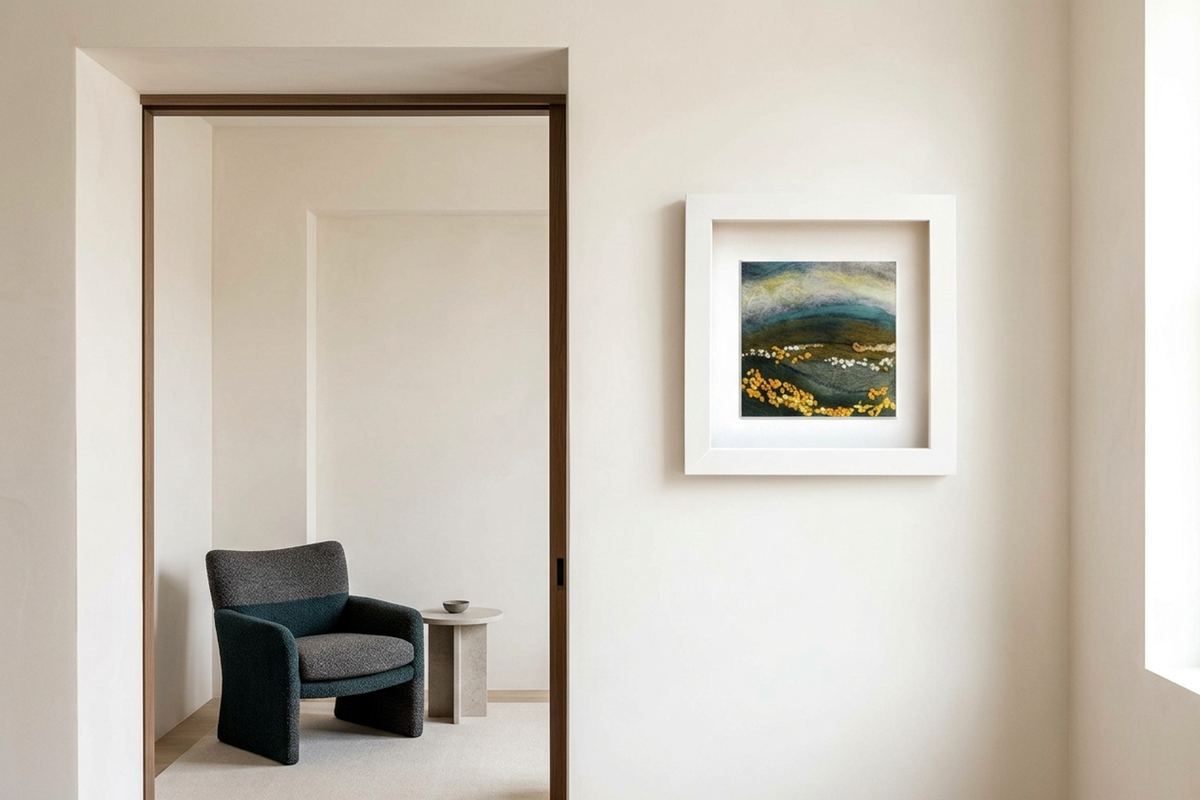
A small wall often offers a clear starting point for choosing art. Its boundaries are easy to see, and a single piece can become the focus without needing a larger arrangement. The useful question is how the artwork will sit within those boundaries and how you will encounter it during an ordinary day.
The felt artwork at fiafibreartstore includes framed landscape and seascape subjects. Before choosing one, spend a little time looking at the wall itself. A position beside a chair creates a different viewing experience from a narrow section of hallway, even when the available wall space is similar.
Measure the space you actually see
Measure the usable area rather than the whole wall. Furniture, a doorway, a light switch or an adjoining shelf can change the amount of space that feels available. Note the width and height of the clear section, then consider how much breathing room you want around the artwork.
Some fiafibreartstore product names include measurements such as 23x23cm or 28x28cm. Check the full listing to understand what a stated measurement refers to. Do not assume it includes the frame or describes the visible image unless the product information says so. Ask for clarification when the distinction affects your choice.
Test a size before choosing
A paper template is a useful way to make a measurement visible. Once you have confirmed the relevant outside dimensions, cut paper to that size and temporarily position it on the wall using a method appropriate for the surface. This lets you judge scale without relying on a number alone.
Look at the template from the places where you normally stand or sit. Move it slightly higher, lower or to one side and notice how the relationship with nearby furniture changes. There is no need to force a centred arrangement if the room feels more balanced another way.
Think about viewing distance
A piece seen at close range invites attention to detail. A piece viewed across a room first reads as an overall image. Both can work, but they encourage different choices. Look at the product photograph at a larger size, then step back from your screen to consider its broader composition.
For a narrow passage, consider whether you will usually see the artwork while moving past it. For a reading corner, consider the view from the chair as well as the doorway. Choose for the experience you will have most often, rather than only for a photograph of the finished room.
Give the subject room
An Irish landscape or seascape can be selected for its subject as much as its relationship with the decor. A personal connection to land or water may matter more than matching every nearby colour. Notice which artwork you return to after comparing several listings.
If the wall already contains shelves or objects, reduce the surrounding visual activity before deciding that the artwork needs to be larger. Leaving a clear area can help a modestly sized piece feel deliberate. You can always reintroduce nearby objects gradually once you have assessed the arrangement.
Make a final practical check
Before making your choice, confirm the stated dimensions, whether a frame is included and any display information provided. Keep separate notes for the size of the wall and the measurements of the artwork so they do not become confused.
A successful choice brings the space, the subject and your own response together. Start with a wall you know well, compare the details carefully, and choose a piece you will enjoy noticing in daily life.